

Let it Flow
New Year’s Invitation To Embrace Natural Rhythms: A REWRITE

Note: This piece has been revised from its original version published almost exactly one year ago to reflect more nuance around diverse experiences with menstrual cycles, birth control, and hormonal health. My intention remains the same: to invite curiosity about cyclical living, while ensuring the language is less dichotomous and more inclusive of the many valid paths to body wisdom.
Living Cyclically
In a world that prioritizes consistency, productivity, and forward motion, cyclical living asks a quieter, more radical question: what happens when we listen to the body instead of ignoring, suppressing, or overriding it?
For those who menstruate, this often begins with honoring this time as a living feedback system that reflects our physical, emotional, and energetic states.
Cyclical living asks us to step out of constant override and into relationship with our bodies as intelligent systems, not problems to be managed.
Much like the moon’s illumination and retreat, the body moves in phases. The longstanding association between the female body, water, and the moon reflects this innate ebb and flow.
Living in greater accordance with my body has been transformational; perhaps most essentially, it has given me permission to rest. I am actively working with the limiting belief that it is not safe for me to relax.
Rest has softened my relationship with productivity and softened FOMO’s pressure. Rest has also strengthened my inner knowing and creativity, particularly during my bleed or inner winter. While the self-critic still sounds, I’ve learned to meet it with compassion rather than force.
Everyone (not just those who menstruate) benefits from understanding hormones. Hormones influence nearly every system in the body, including mood, energy, sleep, appetite, stress response, focus, libido, pain perception, inflammation, digestion, and skin health. Because hormones are involved in, well, EVERYTHING, understanding how they fluctuate helps us make sense of shifts that are often misunderstood or dismissed rather than physiological communication.
Lunar living stands in contrast to the linear framework of modern society, which is largely structured around a 24-hour schedule. While many people with typical male physiology experience hormonal patterns that fluctuate primarily on a daily rhythm, many people with typical female physiology experience hormonal shifts across a roughly monthly cycle. These rhythms often support alternating phases of outward engagement and inward reflection, signals of a different biological intelligence that our culture has yet to fully honor.
Unfortunately, female physiological fluctuations are often labeled “bitchy,” inconvenient, or something to swallow an Advil and push through. I argue these shifts are not problems to be managed or medicated away, but signals to slow down and renew.
Silence Around Bleeding
If you feel uneasy talking about periods, it’s worth considering how that discomfort has been socially conditioned. I explored this in my master’s thesis, Women Acting Out, where I examined the double standards placed on women: expected to be sexually appealing while simultaneously suppressing natural signs of maturity such as body hair, hormonal changes, and menstruation. This contradiction often produces a subtle sense of inadequacy, as if something about us is inherently wrong.
Take The Birth of Venus by Sandro Botticelli. Venus’s idealized body (hairless, youthful, flawless) reflects society’s demand for an impossible blend of purity and desirability. There’s little room here for the real, mature bodies we actually inhabit: bodies with pubic hair, cellulite, stretch marks, and menstrual blood. This image, along with countless others like it, has shaped Western ideals of femininity for centuries.
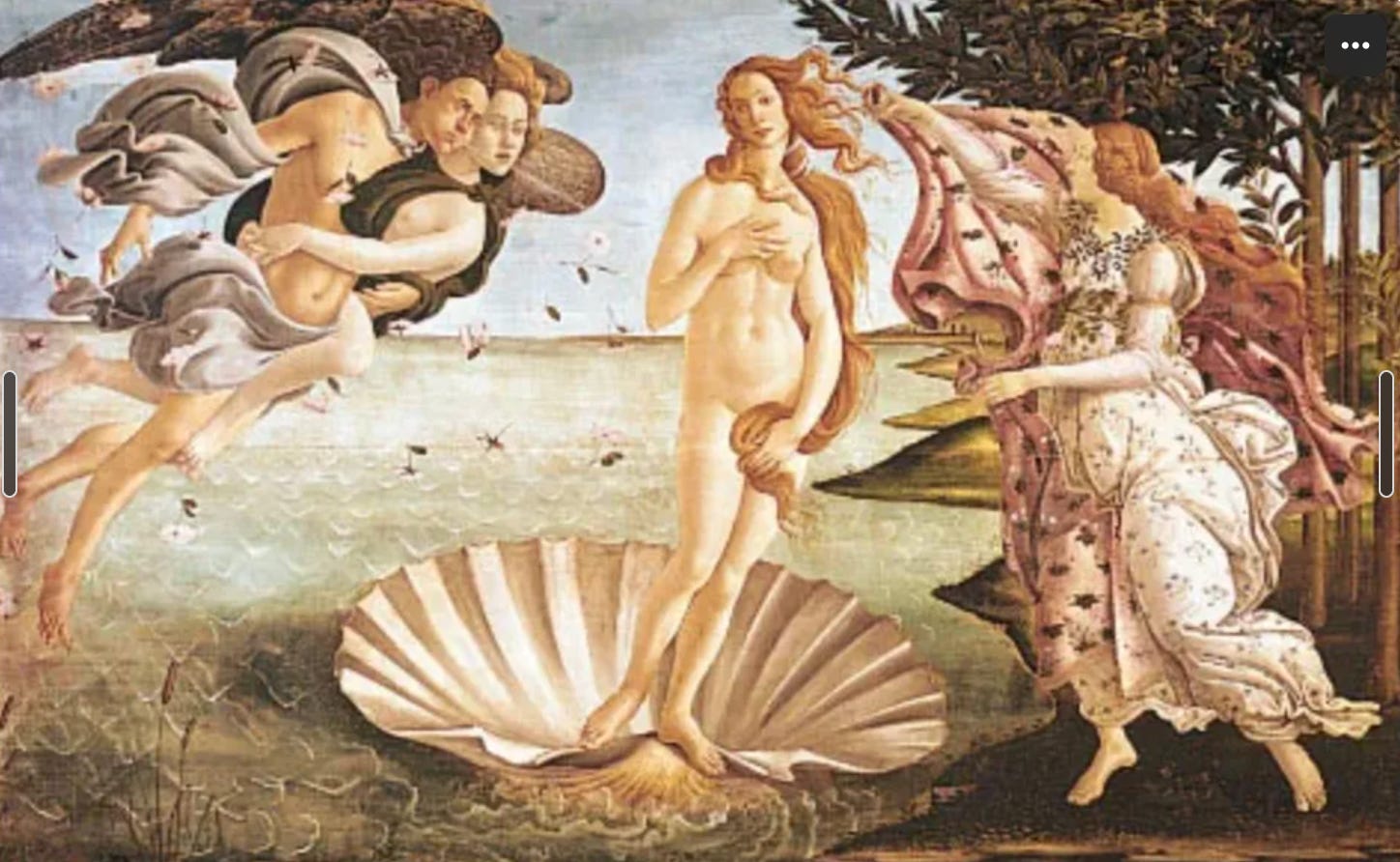
A menstrual cycle is a natural marker of maturity and fertility, yet it has long been stigmatized. The familiar phrase, “Ugh, my period,” obscures a deeper truth: our bodies are capable, healthy and working intelligently.
When bleeding becomes something to endure rather than understand, it’s easy to disconnect from what the body is communicating.
Why Wasn’t I Taught This?
Many were placed on birth control to “regulate” or treat symptoms like acne or pain, sometimes without education about the root causes.
When people express concern about me being off hormonal birth control, often asking, “Aren’t you afraid you’ll get pregnant?” I share that learning about my cycle has actually increased my sense of responsibility, confidence, and awareness of my body. Through education, I’ve learned that fertility occurs within a limited window each cycle (typically about five to six days) due to sperm survival and the brief window of ovulation itself. I plan accordingly by using protection or abstaining during that time.
This approach, known as the Fertility Awareness Method (FAM), works for me because I've developed bodily fluency and am in a stable situation where informed planning is possible. This is not the right choice for everyone. What I advocate for is not abandoning hormonal contraceptives necessarily, but ensuring that people have access to comprehensive reproductive literacy so decisions are made from knowledge rather than fear.
Reclaiming Cycle Knowledge
In many ancient cultures, monthly bleeding was revered as sacred. Women gathered in dedicated spaces for reflection, healing, and intuitive deepening. Anthropological evidence suggests that menstruating women often held spiritual authority, offering guidance that influenced communal decisions (more in Keep Flowing). Over time, this reverence was eclipsed.
While modern medicine has brought invaluable advancements, and hormonal birth control has been genuinely life-changing for many, the issue arises when medical intervention becomes the only narrative (because let’s face it, it is the dominant discourse), without education about internal feedback systems or cycle awareness.
Hormonal birth control plays an important role in reproductive autonomy and in the management of conditions such as endometriosis and PCOS. The concern is not the medication itself, but its frequent presentation without sufficient education around hormonal physiology and informed choice. Importantly, individuals using hormonal contraceptives can still benefit from understanding their body’s cyclicality and endocrine patterns.
Four Inner Seasons
The lunar cycle offers one framework for understanding cyclical shifts on a monthly basis. Many people experience four general phases, often referred to as inner seasons:
Inner Spring (Follicular Phase)
Following menstruation, estrogen begins to rise, often bringing increased mental clarity, motivation, and creative energy. Many experience a renewed sense of optimism and forward momentum during this phase. Neurologically and hormonally, this can be a supportive time for learning, initiating projects, and engaging in higher-intensity or exploratory movement.
Inner Summer (Ovulatory Phase)
Around ovulation, estrogen peaks and is briefly joined by testosterone, which can enhance confidence, verbal fluency, and social ease. This phase often supports outward expression, collaboration, visibility, and connection. Biologically primed for communication and bonding, many feel most “seen” and embodied here.
Inner Fall (Luteal Phase)
As progesterone rises and estrogen declines, energy often shifts inward. This phase supports completion, discernment, and emotional honesty. Heightened sensitivity (including PMS) is information: a signal from the nervous system and endocrine system that slower pacing, clearer boundaries, and increased self-care may be required.
Inner Winter (Menstruation)
When estrogen and progesterone drop, the body enters a physiologically low-energy state. This phase invites rest, introspection, and internal processing. Many experience increased intuition, symbolic thinking, and emotional insight here, an inward turning that mirrors the body’s need for repair and renewal.
Not everyone experiences these phases in a linear or predictable way. Conditions like PCOS, endometriosis, perimenopause, or natural variation mean some bodies don’t follow this pattern. The invitation is not to force your experience into a box, but to develop curiosity about your unique rhythm. Medical care and cycle awareness can coexist.
If this resonates, consider it an invitation to relate to yourself differently. This may look like resting when energy drops instead of caffeinating, questioning the urge to “push through” or “grind it out,” or learning to distinguish between signals that require medical care and those that call for nourishment, boundaries, or slowing down… I believe the ripple effects would extend beyond individual well-being, reshaping how we work, relate, heal, and care for one another. I believe my body is not an obstacle to overcome, but a trusted ally worth listening to.
Disclaimer:
This piece is educational and reflective in nature and is not intended as medical advice. Menstrual cycles, hormonal health, fertility, and contraception are deeply individual and influenced by many factors, including medical conditions, life stage, stress, and access to care. Hormonal birth control, fertility awareness methods, and other interventions each have benefits and limitations. I encourage readers to work with qualified medical and holistic practitioners when making decisions about their bodies and reproductive health.
Love this so much 💖
I really need to track my period better to understand my energy levels and why yes, they are constantly fluctuating along w my mood. Inspiring! I like that you laid out each part of the cycle and generally what to do in each.