Keep Flowing
Remembering Our Forgotten Rhythm

Imagine what would happen if each woman remembered her innate connection to her body.
The world feels off-kilter. Our culture prioritizes linearity, output, and productivity, built around a 24-hour cycle suited to masculine biology — ignoring the natural ebb and flow of female rhythms. Women’s hormones don’t reset daily; they cycle with the moon, the seasons, and the tides. So the idea that “consistency is key” isn’t entirely true for us. It’s not about showing up the same way every day, but about honoring the shifts that happen over the course of a month. Yet somewhere along the way, we were taught to ignore this innate, bodily rhythm.
We’ve been conditioned to mirror the masculine: to push through and overdo. At the same time, we’ve been conditioned in our wounded feminine to over-give and struggle with saying “no” without over-explaining or excusing ourselves (even though no is a complete sentence). As the outer world dismisses our bodily needs, we’ve learned to do the same. No wonder so many of us feel exhausted, stressed, and disconnected from our bodies.
For centuries, women recognized their bodies as sacred, and their menstrual cycles as a source of wisdom. Ancient cultures aligned their calendars and spiritual practices with the lunar cycle, honoring this connection.
Indigenous tribes, including many Native American nations, practiced Moon Lodges, where women gathered during their bleed to rest, reflect, and receive visions.
In Mesopotamia, the goddess Inanna (Ishtar) was worshipped in connection to the moon and fertility, with priestesses engaging in rituals that honored their cycles.
The Egyptians associated menstruation with Isis, believing menstrual blood carried regenerative power.
Hindu traditions linked the goddess Shakti, divine feminine energy, to the cycles of creation, destruction, and rebirth.
The Celts saw menstruation as a time of heightened spiritual power, aligning it with lunar and seasonal rhythms.
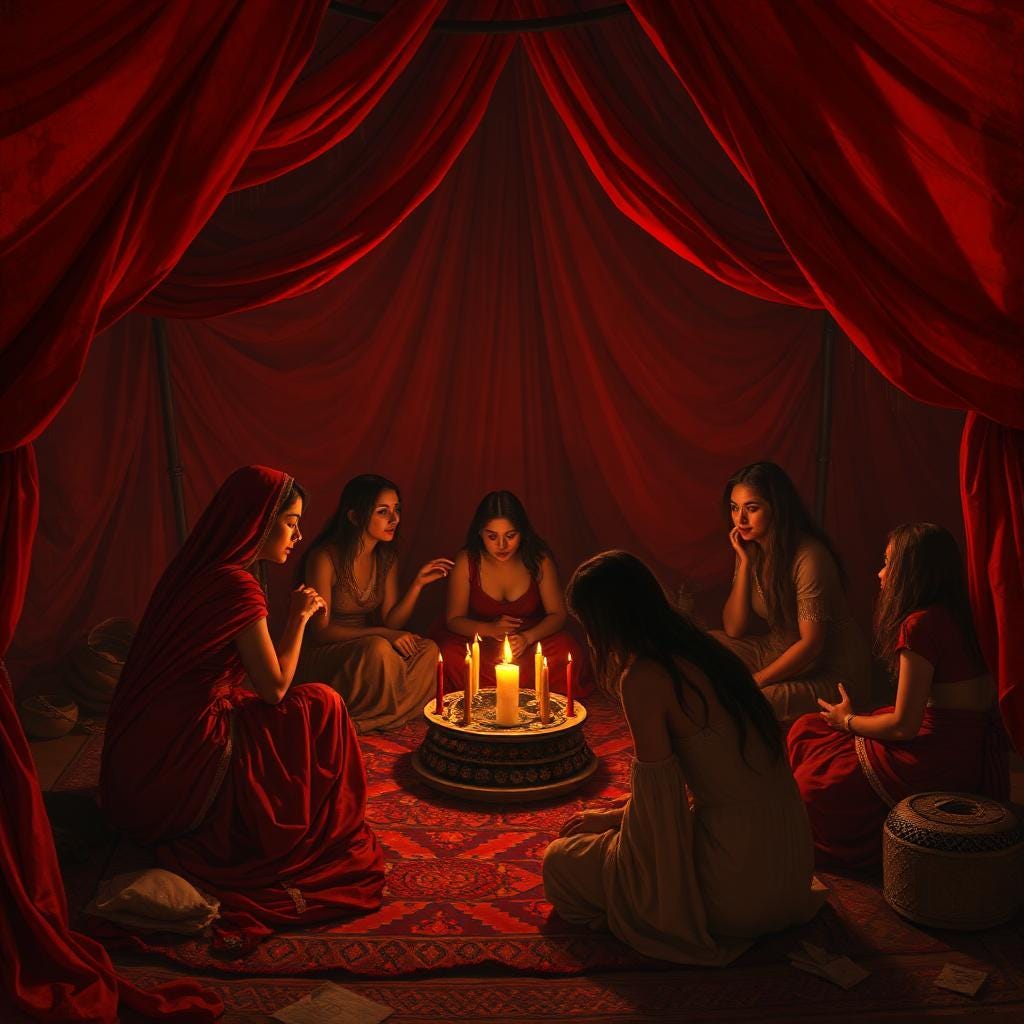
The Red Tent, a sacred space in the Middle East, offered women a place of rest, reflection, and renewal—where they shared wisdom, honored their cycles, and received messages for their communities.
Early Hebrew women likely practiced similar menstrual retreats, reflecting a time when these cycles were seen as spiritually significant rather than inconvenient.
These ancient practices contrast sharply with today’s widespread view of menstruation: as something to control or hide rather than a source of power and reflection. Imagine a world where women weren’t shamed for their emotions but revered for their intuition and wisdom. What if we reclaimed our cycles as a source of strength and guidance?
Yet, modern life has severed this connection. We’ve been conditioned to view our cycles as inconveniences — something to silence with birth control, discard with tampons, and override with caffeine to power through fatigue, all driven by relentless demands of hustle culture. We forget that our cycle is a natural rhythm, a built-in blueprint for self-regulation, if only we allowed ourselves to listen.
The Fifth Vital Sign
Doctors track heart rate, blood pressure, and oxygen levels to assess health, but what about menstrual cycles? The truth is, a woman’s cycle is just as much a vital sign as any of these, according to fertility educator Lisa Hendrickson-Jack, author of The Fifth Vital Sign. When our hormones are in balance, our cycles run smoothly. But when something is off, whether it’s stress, nutrient deficiencies, or deeper imbalances, our cycle is often the first to tell us.
❌ Missing periods? Your body might be in survival mode.
❌ Heavy, painful periods? Your estrogen levels might be too high.
❌ PMS mood swings? Your body could be asking for better nourishment and rest.
Yet, instead of addressing the root causes, the default solution has often been hormonal birth control: a quick fix that shuts down our natural cycle, leaving us unaware of the underlying imbalance. It’s easy and convenient, but what happens when we silence our body’s signals instead of listening? We feed into a hyper-masculine culture of productivity, pushing through and squeezing out the feminine energy that calls for rest, ease, spontaneity, and creativity.
When I first started tuning into my cycle, I realized I had been fighting against myself for years. I expected myself to have the same energy, creativity, and motivation every day. But the truth is, my body was meant to move in month-long cycles. Once I began aligning my life with my natural rhythm, everything changed.
Living in Alignment with Your Inner Seasons
Each month, our bodies move through four distinct phases, reflecting the shifting seasons and the moon’s cycles. Honoring these rhythms allows us to flow with life rather than resist it. Even if your cycle is irregular, syncing with the moon’s phases can help restore balance and reconnect you to your natural rhythm.
🌱 Inner Spring (Follicular Phase, Waxing Moon): Like the waxing moon, we are growing, expanding, and stepping into possibility. As estrogen rises, so does our energy, creativity, and motivation. This is a time of renewal; perfect for setting intentions, starting new projects, and engaging in movement that builds strength and momentum.
☀️ Inner Summer (Ovulation, Full Moon): At our peak, we are radiant, magnetic, and expressive. Just as the full moon illuminates the nightsky, our energy is at its highest, making this the best time for social connection and visibility. This is the season of outward energy, ideal for frisky dancing, networking, and stepping into leadership roles.
🍂 Inner Fall (Luteal Phase, Waning Moon): As progesterone rises, energy begins to turn inward. This is a time to tie up loose ends, create boundaries, and release; mirroring the waning moon’s gentle retreat into darkness. If we resist this shift and continue at full speed, PMS symptoms may surface as a signal to slow down.
❄️ Inner Winter (Menstruation, New Moon): The body asks for rest. This is the time for surrender: journal, meditate, and just be. Like the new moon, we are in a state of renewal, shedding the old to make space for the new. Forcing productivity here only leads to burnout; embracing a sacred pause offers clarity and inner wisdom.
Aligning with these shifts has been one of the most empowering changes in my life. Rather than fighting against my body, I’ve learned to move with it. Even though I still hear the voice of the self-critic urging me to “do more,” I’ve learned to meet it with understanding and compassion. I am also strengthening my “NO,” especially in the second half of my cycle.
Why This Matters
Women’s disconnection from their cycles isn’t just an individual issue; it’s a collective one. When we disconnect from our natural rhythms, we disconnect from our femininity and our inherent power. The more we suppress, the less we experience; the less we experience, the more we allow ourselves to be controlled.
For too long, we’ve handed over our bodies to pharmaceuticals, our instincts to algorithms, our inner voice to external validation. We’ve outsourced our knowing. But something is shifting, and more of us are waking up. This awakening isn’t just for individual empowerment, it's a radical act of reclaiming our sovereignty and rebalancing collective energy.
In a world that often rewards endless doing, suppressing our natural cycles has been a way to conform to a system that doesn’t honor our necessary being. But by reconnecting with our bodies, we’re not just healing physically; we’re reclaiming a feminine force that can guide us towards more balanced, compassionate, and sustainable ways of being.
If we can remember how to honor our cyclical nature, we have the potential to transform the way we live. Let’s move into the wisdom of our bodies.